


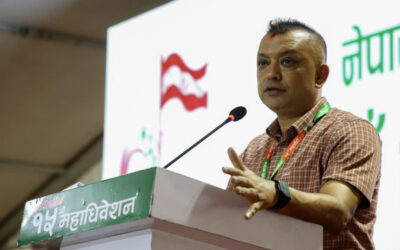
KATHMANDU- Nepali Congress President Gagan Kumar Thapa has said it is wrong to assume that public support will always remain intact simply because a party has secured a majority or a two-thirds mandate in an election, taking a swipe at former party president Sher Bahadur Deuba and the leadership of the then government.
Speaking at a book launch and felicitation programme organised by the Nanda Prasad Januka Foundation, Thapa said he had repeatedly warned the then Congress leadership about growing public dissatisfaction, but his concerns were not taken seriously.
“Even a two-thirds majority is being questioned now. A person who has been prime minister five times becomes dissatisfied because he could not become prime minister for a sixth time. A person who has been party president twice becomes dissatisfied because he could not become president for a third time. Ambition keeps growing in this way,” he said.
Thapa said numbers obtained through elections alone are not sufficient in a democracy. Continued public support, moral leadership and citizens’ trust are equally important, he said.
He recalled repeatedly raising his disagreements and concerns with then party president Sher Bahadur Deuba and KP Sharma Oli.
Thapa claimed the leadership at the time did not seriously consider the problems they had identified or the suggestions they had offered, adding that they too had paid a political price as a result.
He said legal validity alone is not sufficient in a democracy and that the moral legitimacy of political decisions and their acceptance by citizens must also be tested.
A decision does not become right simply because it has enough numerical support, Thapa said, adding that whether the public accepts it is an important question.
“Numbers alone are not everything in democracy,” Thapa said. “We also have to see whether citizens accept it and whether society believes in it.”
Thapa also said that treating the attainment of state positions as the sole measure of political success had created significant dissatisfaction within political parties.
He said the tendency to regard a political career as a failure if one does not become a minister, lawmaker, mayor or party president has turned political parties themselves into structures that generate dissatisfaction.
Thapa also expressed the view that some Supreme Court rulings concerning the Nepali Congress special general convention and internal legitimacy should be reviewed.
He argued that although court decisions may be legally valid, the extent to which they gain legitimacy in society is also important.


Comments
Share your opinion or feedback. Please keep comments respectful and constructive.