


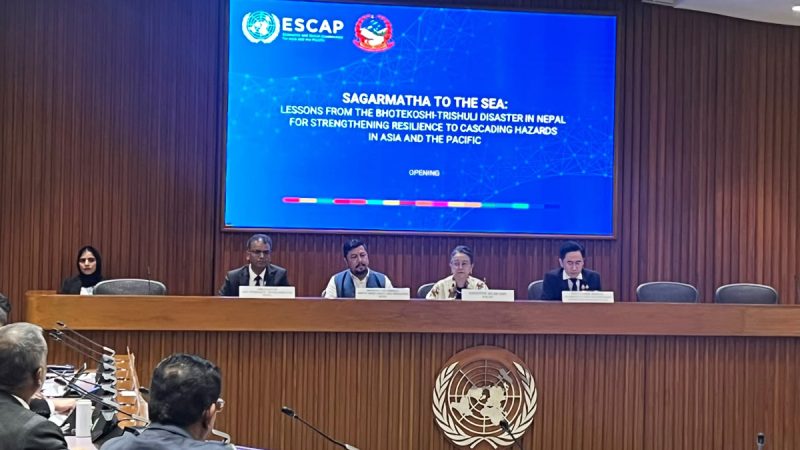
BANGKOK: Nepal has organised a high-level regional dialogue in Bangkok to share lessons from the Bhotekoshi-Trishuli disaster and discuss the growing risks climate change poses to mountain regions and communities across Asia and the Pacific.
The dialogue brought together ministers from Asia-Pacific countries to discuss Nepal’s experience of climate-related crises and successive disasters, including the challenges facing Himalayan regions as global temperatures rise.
The event, titled From Sagarmatha to the Sea: Lessons from Nepal’s Bhotekoshi-Trishuli Disaster to Prevent Cascading Disasters in the Asia-Pacific Region, was held on Thursday on the sidelines of the fifth ministerial conference of the United Nations Economic and Social Commission for Asia and the Pacific (UN ESCAP).
Nepal jointly organised the event with UN ESCAP at the United Nations Conference Centre in Bangkok. Ministers, diplomats, scientists and disaster management experts from across the Asia-Pacific region attended.
Participants were briefed on a major avalanche in Nepal’s high Himalayan region in August, which triggered a series of severe disasters along the Bhotekoshi and Trishuli river corridors. The events caused substantial damage to hydropower projects, road infrastructure, border mechanisms and local livelihoods, according to the information presented at the dialogue.
Scientists warned that, as global warming pushes temperatures beyond the 1.5-degree Celsius threshold, disasters in the Himalayan region are increasingly emerging as cascading risks that can extend beyond national borders and affect downstream communities.
Nepal calls for early warning systems and technology
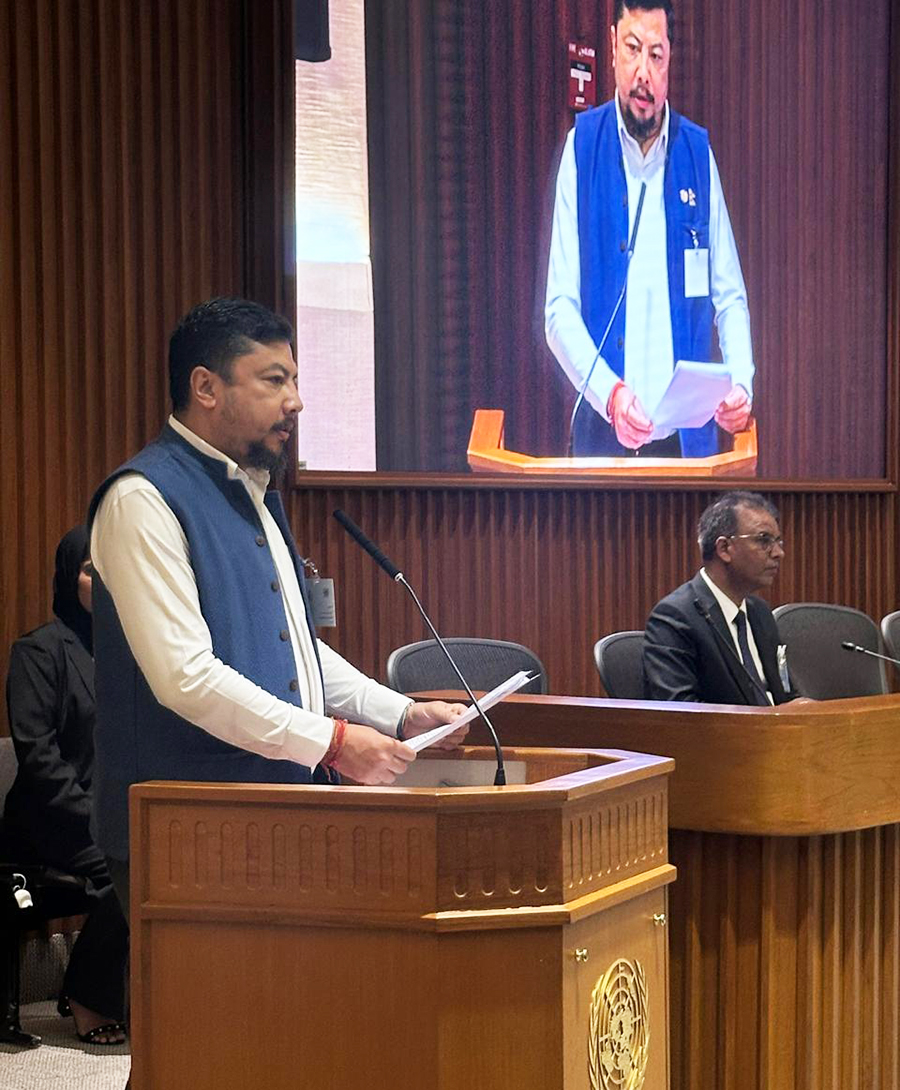
Opening the dialogue, Nepal’s Energy, Water Resources and Irrigation Minister Biraj Bhakta Shrestha described the Bhotekoshi-Trishuli disaster as a warning for the entire Asia-Pacific region, not just Nepal.
He stressed the need for international cooperation, satellite and digital technologies, and financial resources to address risks in mountain regions.
Nepal’s ambassador to Thailand, Dhan Bahadur Oli, and UN ESCAP Executive Secretary Armida Salsiah Alisjahbana also emphasised the importance of regional data sharing and integrated early warning systems to protect ecosystems stretching from mountain regions to the sea.
The discussions focused on three main areas to strengthen disaster resilience.
These included conducting detailed assessments of interconnected risks arising from climate change, changes in the cryosphere and geological shifts; enabling neighbouring countries to exchange emergency data, hydrological measurements and risk information promptly during crises; and improving early warning systems through space technology, satellite mapping, artificial intelligence and youth-focused technological solutions.
Nepal was represented at the dialogue by National Planning Commission member Sanjay Acharya, National Disaster Risk Reduction and Management Authority Chief Executive Dharmaraj Upreti, and Department of Hydrology and Meteorology Director General Archana Shrestha, who delivered papers and analytical presentations.
Ministers from Thailand, Bhutan, Fiji, Samoa, Sri Lanka and Kyrgyzstan also participated. Representatives of China’s National Development and Reform Commission, the Indian Space Research Organisation, the World Meteorological Organization, the International Centre for Integrated Mountain Development and the Asian Development Bank, among other institutions, stressed the need for a regional action agenda to strengthen resilience in mountain regions.
Nepal expects the dialogue to support its reconstruction and recovery efforts while helping other Asia-Pacific countries develop policy guidance and shared strategies for managing cascading disasters.
53 countries support Nepal’s regional space cooperation proposal
Nepal’s proposal for regional space cooperation to improve climate disaster preparedness in the Asia-Pacific region has received support from 53 countries, which have pledged to cooperate.
Minister Shrestha proposed regional cooperation on the use of space technology, access to satellite information and data sharing to help countries respond to climate-related disasters.
The initiative aims to strengthen regional preparedness through improved access to technology and information.







Comments
Share your opinion or feedback. Please keep comments respectful and constructive.