



Nepal is often recognized as a country with forward-looking climate policies. It has been a strong advocate for climate finance on global platforms, calling for international funding to strengthen community resilience and enhance adaptation capacity. In addition to being among the world’s 10 most climate-vulnerable countries, Nepal became the first country to introduce Climate Budget Tagging (CBT) in 2012. The system was designed to classify and track public expenditure related to climate change.
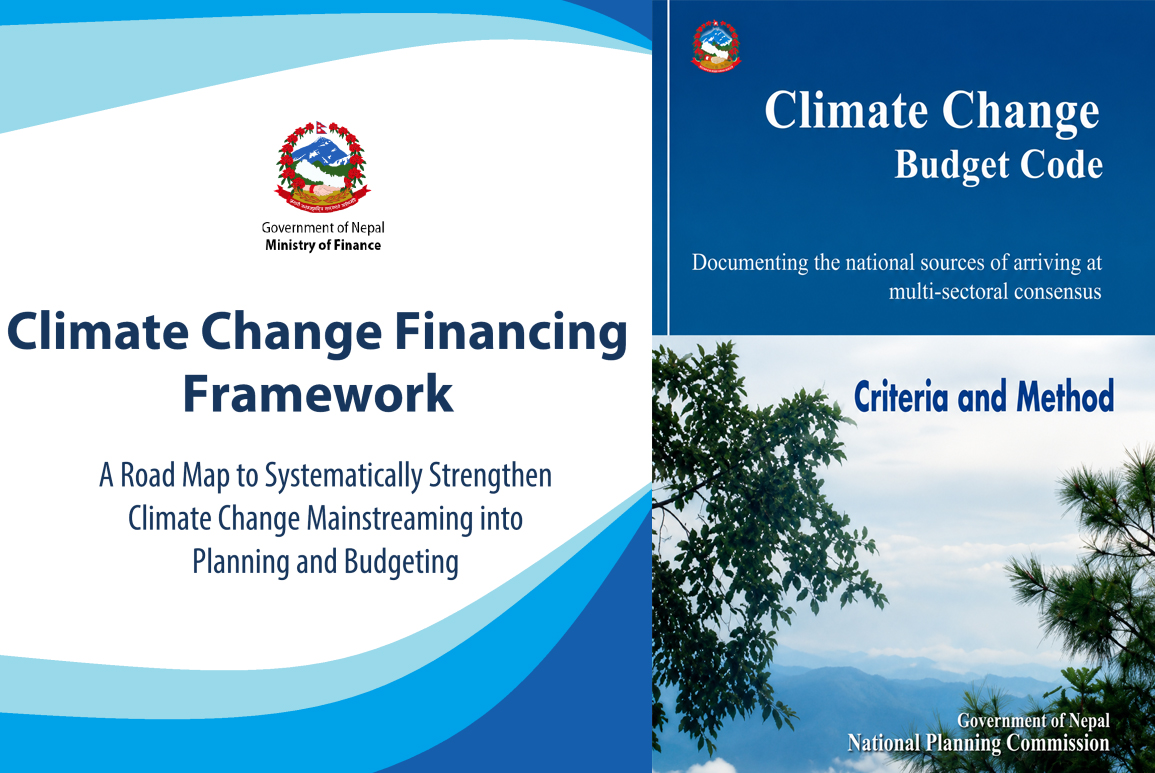
The Ministry of Finance has led its implementation. The system is applied at the project level rather than the activity level. Under the framework, national-level projects are classified as directly relevant, indirectly relevant or neutral according to their contribution to climate action. They are then categorized into areas such as adaptation, mitigation or combined benefits. To further strengthen climate finance management and tracking, the Ministry of Finance also approved the Climate Change Financing Framework (CCFF) in 2017.
Nepal’s Climate Change Policy, National Adaptation Plan (NAP) and Nationally Determined Contribution (NDC) have further reinforced the country’s commitment to development that supports climate resilience and low-carbon emissions. The government has also advanced the Local Adaptation Plan of Action (LAPA) framework to ensure that planning takes place at the local level. It has also committed to channeling 80 percent of total climate finance to the local level.
On paper, these policies, systems and institutional structures appear impressive. They are aligned with global practices and reflect institutional thinking. The reality, however, is different.
A System That Exists but Is Barely Used
Discussions with local government officials point to a common conclusion: the Climate Budget Tagging system exists, but its practical use remains very limited. In many places, officials are either unfamiliar with the system or have not received the training needed to implement it effectively. Institutional efforts to integrate CBT into local planning and budgeting processes also appear limited.
This does not mean that climate-related work is not taking place. Municipalities routinely allocate budgets to areas such as energy, agriculture, forests and natural resource management. Yet these expenditures are not systematically tagged, tracked or reported as climate finance. As a result, significant climate-related investments remain invisible within the formal system.
For example, a preliminary analysis of the budgets of Devchuli and Gaindakot municipalities under the CBT framework indicates that approximately 10 to 15 percent of their annual budgets could be considered climate-related expenditure. Because there is no formal tagging, however, these figures are not captured in the reporting system.
Local officials themselves acknowledge this weakness. An official from one municipality said, “The work is being done. We have only now realized that these activities are climate-related. But so far, they have not been recorded as climate interventions.”
The official added, “We prepare our annual plans through a participatory process, but to my knowledge, climate tagging has not been used.”
This suggests that many local-level employees are either unfamiliar with climate finance mechanisms or lack the technical capacity required for climate budgeting, reporting and monitoring. According to officials in planning divisions, CBT could be incorporated if the necessary training were provided before the planning process begins.
Why Does Tracking Matter?
At first, this may appear to be a technical problem. Its implications, however, are much deeper. Without proper tracking, it is difficult to determine how much Nepal is investing in climate-related areas. It is also difficult to measure how effective those investments are. Most importantly, the country’s ability to attract additional climate finance from international sources could be weakened.
The global climate finance system is increasingly centered on transparency, performance and accountability. Funds such as the Green Climate Fund (GCF), Global Environment Facility (GEF) and Adaptation Fund expect vulnerable countries such as Nepal to demonstrate not only commitment but also measurable results. If Nepal cannot clearly show where and how climate finance is being used, it could miss such opportunities.
The Question of Equitable Access: Who Is Receiving Climate Finance?
Nepal’s climate policies have consistently emphasized giving priority to poor households, women, marginalized communities and people living in areas vulnerable to climate risks. But without clear expenditure records, it is difficult to determine whether these communities are actually benefiting.
The central question is this: Is climate finance reaching the communities most at risk?
The current situation raises the possibility that communities with better access or greater influence may receive more resources, while vulnerable communities in remote areas are overlooked. Without clear systems for tracking and prioritization, the goal of equity may remain confined to policy rather than being realized in practice. The failure to apply Climate Budget Tagging in the planning process further reinforces this imbalance.
A Growing Dilemma for the Future
As global climate funds increasingly focus on results-based finance, transparency and accountability, Nepal will need to demonstrate its capacity to make effective use of those resources.
This is where Nepal faces a major dilemma. Policies and institutional structures for tracking climate finance have been established, but they have not been effectively implemented in practice. At a time when global climate finance is expanding, Nepal risks missing out on resources. The problem is not necessarily that funding is unavailable, but that the mechanisms needed to demonstrate how it is being used are not yet fully operational.
If local governments cannot demonstrate how climate investments are being made and what impact they are having, it will be difficult to take advantage of available financing opportunities, particularly those from international sources.
Meanwhile, another challenge for climate finance governance in Nepal is the mismatch between growing adaptation needs and domestic financial capacity. The National Adaptation Plan (NAP) 2021/2050 identifies climate resilience as a national priority. Yet approximately 90 percent of its financing needs depend on external sources. The GCF, Adaptation Fund, GEF, bilateral and multilateral donors, and other international mechanisms are among the major sources.
Access to these funds, however, requires climate budget tracking, transparent reporting and evidence of impact. Institutional and technical capacity in these areas appears weak, particularly at the provincial and local levels.
How Can the Gap Be Narrowed?
Closing this gap will require stronger climate finance governance, institutional capacity and accountability systems at all levels. The most important step is to institutionalize Climate Budget Tagging within local planning and budgeting processes.
Climate-related investments should be tagged not only at the project level but also at the activity level so that their actual contribution to adaptation and mitigation can be measured. This would help local governments clearly demonstrate where climate finance is being spent and what outcomes are being achieved.
Capacity building is equally important. Regular training, technical guidance and the deployment of staff focused on climate issues at the local and provincial levels could make the planning process more effective.
Similarly, a robust Monitoring, Reporting and Verification (MRV) system needs to be developed. International climate funds require evidence showing how investments have reduced risks and strengthened resilience. It is therefore essential to strengthen data systems, impact assessment and documentation processes.
Coordination and ownership among federal, provincial and local governments are equally important. At present, responsibilities related to climate finance are dispersed across different agencies, resulting in duplication and weak reporting. Integrating climate finance into regular development planning, with clearly defined roles, could make the system more effective.
Conclusion
Nepal has already established a strong policy framework for climate finance. The challenge now is to translate it into effective implementation.
Ultimately, climate finance is not merely a matter of policy or budgets. It is assistance that must reach the communities that need it most. If the systems remain confined to paper, the commitments on climate finance will remain on paper as well. But if these systems are put into practice, they can serve as powerful instruments for building community resilience.
Through stronger governance, effective data systems, enhanced local capacity and institutional coordination, Nepal can gradually narrow the gap between its climate finance needs and their implementation.
The author is a researcher on climate change and environmental issues at ForestAction Nepal.
Comments
Share your opinion or feedback. Please keep comments respectful and constructive.