


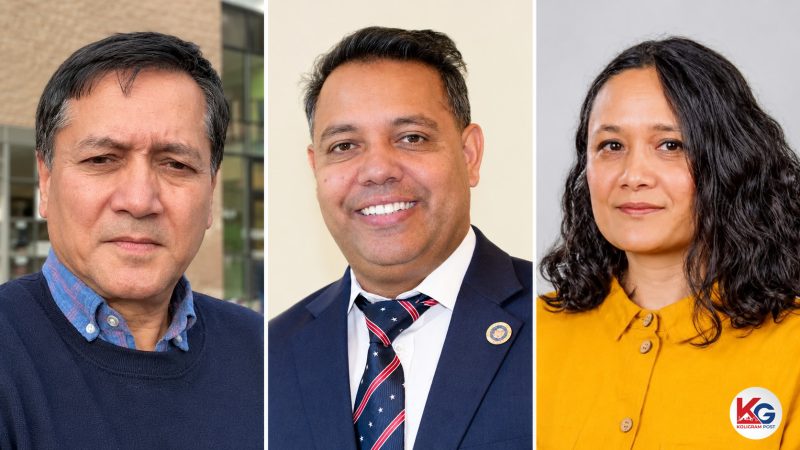
KATHMANDU: Three American candidates of Nepali origin have won seats in state legislatures in the US midterm elections held on November 3.
Sarahana Shrestha was elected to the New York State Assembly, Dr Harry Bhandari to the Maryland House of Delegates, and Bishwabahadur Shah to the New Hampshire House of Representatives.
All three are candidates of the Democratic Party. Shrestha and Bhandari are incumbent lawmakers who have secured support for a third term. Shah, meanwhile, has entered a state legislature for the first time after contesting an election.
Four candidates of Nepali origin contested state legislative seats across three states in this election. Three were elected, while Satish Chapagain, who ran in Maryland, was defeated.
Sarahana Shrestha wins third term in New York
Sarahana Shrestha has been re-elected for a third term in the New York State Assembly. Contesting from District 103, she defeated her Republican opponent, Santos Lopez.
According to available preliminary results, Shrestha secured 38,606 votes, or around 69 per cent. Lopez received 16,821 votes, or approximately 30 per cent.
Shrestha was first elected in 2022 and won a second term in 2024. Her new term will begin on January 1, 2027.
Born in Kathmandu, Shrestha moved to the United States in 2001 as a student. She became a US citizen in 2019. Before entering politics, she worked as a climate campaigner and graphic designer.
She campaigned against fossil fuel-based energy projects in New York’s Hudson Valley region and worked to promote clean energy and public energy management.
Her political priorities have included energy, environmental protection, housing, healthcare, workers’ rights and social security.
Shrestha is the first American of Nepali origin to serve in the New York State Assembly. She is also the first woman of Nepali origin to be elected to a state legislature anywhere in the United States.
Harry Bhandari wins third term in Maryland
Dr Harry Bhandari has been elected for a third time to the Maryland House of Delegates.
Bhandari contested from District 8, where three candidates are elected. According to preliminary results released by the Maryland State Board of Elections, he received 18,748 votes, or 22.29 per cent, with results counted from 33 of the district’s 36 polling centres.
Democratic candidates Nick Allen and Kim L. Ross received 19,036 and 18,534 votes, respectively. All three Democratic candidates were leading in the available results. As counting was not complete, the figures cannot be treated as final results.
Bhandari was first elected in 2018, becoming the first American of Nepali origin to serve in a US state legislature. He was re-elected in 2022 and has now secured another term.
Before moving to the United States in 2005, Bhandari worked in Nepal as a teacher, writer, school principal and professor.
He studied at Johns Hopkins University and earned a doctorate in Language, Literacy and Culture from the University of Maryland, Baltimore County.
In the United States, he worked as a schoolteacher and remained active in political and community affairs. He has also served as chair of the Maryland Asian American and Pacific Islander Legislative Caucus.
He currently chairs the Subcommittee on Land Use and Zoning under the Economic Matters Committee of the Maryland House of Delegates.
Bishwabahadur Shah elected for the first time
Bishwabahadur Shah, a first-generation American of Nepali origin, has been elected to the New Hampshire House of Representatives.
A resident of Manchester, Shah contested from District 41 in Hillsborough County. He secured the Democratic Party nomination in the primary election before entering the general election.
According to preliminary results, Shah received 5,726 votes, finishing third in a district that elects three representatives.
The New Hampshire House of Representatives has a total of 400 members. Some districts elect more than one representative. In District 41, the three candidates receiving the highest number of votes win seats.
Shah’s victory means that Americans of Nepali origin will now also have representation in the New Hampshire state legislature.
Satish Chapagain defeated in Maryland
Satish Chapagain, another candidate of Nepali origin who contested in the election, was unsuccessful.
Chapagain ran for the Maryland House of Delegates from District 7A. He had secured the Democratic Party nomination by winning the primary election.
According to the available results, he received 10,462 votes, or 20.15 per cent. The district elects two representatives.
Republican candidates Ryan Nawrocki and Kathy Szeliga won the two seats with 15,802 and 15,420 votes, respectively. Chapagain finished third.
Nepali-American representation expands in US politics
The participation of Americans of Nepali origin in mainstream US politics has grown in recent years. Harry Bhandari and Sarahana Shrestha are among the prominent examples.
When Bhandari was elected to the Maryland House of Delegates in 2018, he became the first American of Nepali origin to serve in a US state legislature. Shrestha’s election to the New York State Assembly in 2022 marked another milestone, making her the first Nepali-origin woman to enter a US state legislature.
In this election, both secured a third term, while Shah won a seat for the first time. Their victories mark a further development in the political representation of Americans of Nepali origin.
These elections were for state legislatures, not the US Congress. State legislatures are responsible for making laws and deciding budgets and policy matters within their respective states.
The election of representatives of Nepali origin in New York, Maryland and New Hampshire reflects the community’s growing presence in state-level political processes.
Of the four Nepali-origin candidates who contested this election, three won their races, expanding the community’s representation across three US states.






Comments
Share your opinion or feedback. Please keep comments respectful and constructive.